

If you have ever had your kundli read, you have likely heard the term Manglik Dosha. And chances are, you heard it with a slight drop in tone. As if a single placement of Mars could decide your entire marital fate.
The reality is more measured.
Manglik Dosha does affect marriage timing. But it does not doom you to a late wedding, a difficult spouse, or a lifetime of struggle. What it actually does is create a specific set of conditions around partnership. Under those conditions, marriage tends to arrive later than average — not because the universe is punishing you, but because Mars energy requires a particular kind of readiness.
This blog explains how that works.
What Exactly Is Manglik Dosha?
Manglik Dosha (also called Kuja Dosha or Mangal Dosha) is formed when the planet Mars occupies any of five specific houses in a natal chart. The houses are:
✨ 1st house (Ascendant) – the self, personality, and body
✨ 4th house – home, mother, and inner peace
✨ 7th house – marriage, partnership, and the spouse
✨ 8th house – longevity, intimacy, and sudden events
✨ 12th house – bed pleasures, loss, and foreign lands
Some astrological traditions also include the 2nd house (family and the formalization of marriage), but the five houses above are the standard reference.
Mars is the planet of energy, aggression, courage, and conflict. When it sits in houses that govern partnership and domestic life, it introduces a specific temperament. That temperament is not inherently bad. But it does require the right partner and the right timing.
Why Manglik Dosha Delays Marriage
The delay caused by Manglik Dosha comes from three observable mechanisms.
First, conflict tendency. Mars in the 7th house directly creates a high potential for arguments, dominance struggles, and friction within a partnership. Because of this, many families and astrologers prefer Manglik-Manglik matching — both partners having the dosha, which neutralizes the effect. Finding a suitable non-Manglik partner who accepts the match takes additional time. The pool is smaller, so the search takes longer.
Second, self-will and independence. Mars in the 1st house makes the native highly self-reliant, ambitious, and resistant to compromise. Such individuals often delay their own marriage. Not because they cannot find a partner, but because they do not want to adjust their lifestyle, career trajectory, or personal space. The delay is self-imposed, not fated.
Third, hidden instability. Mars in the 4th, 8th, or 12th house does not directly touch the 7th house. However, it creates turbulence in domestic life (4th house), intimacy or sudden breaks (8th house), or financial and distance-related obstacles (12th house). Marriage may be postponed until the native stabilizes these areas of life.
In summary: Manglik Dosha delays marriage because it narrows the pool of compatible partners and because the native themselves may not be emotionally ready for the compromises marriage requires. The delay is functional, not punitive.
How Much Delay Is Typical?
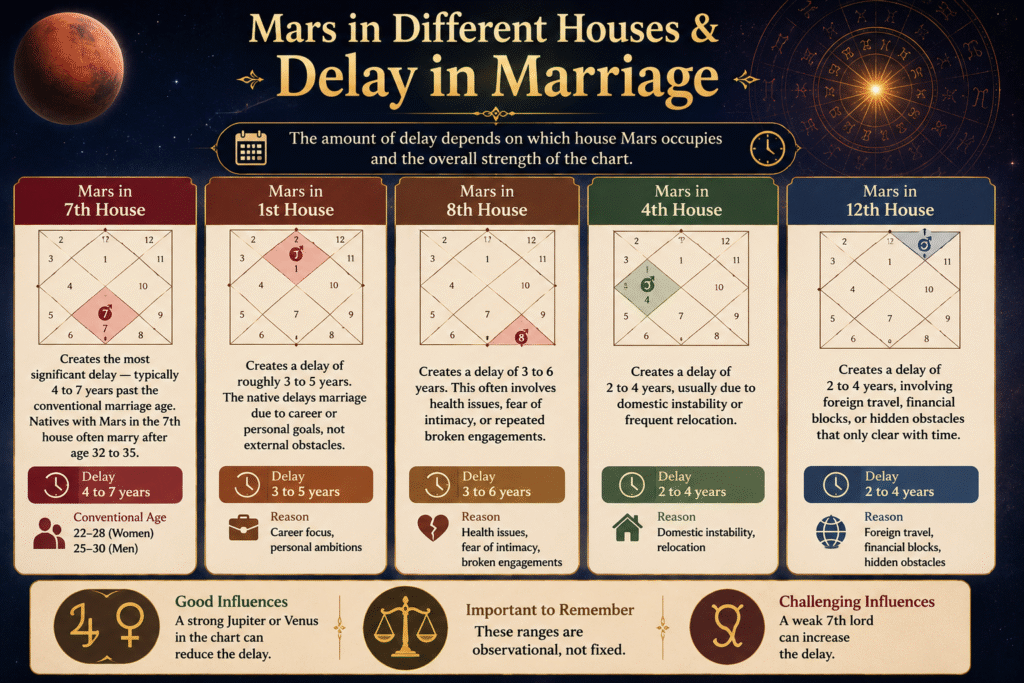
The amount of delay depends on which house Mars occupies and the overall strength of the chart. General observational ranges are as follows.
🔮 Mars in the 7th house creates the most significant delay — typically 4 to 7 years past the conventional marriage age (conventional being 22–28 for women and 25–30 for men). Natives with Mars in the 7th house often marry after age 32 to 35.
🔮 Mars in the 1st house creates a delay of roughly 3 to 5 years. The native delays marriage due to career or personal goals, not external obstacles.
🔮 Mars in the 8th house creates a delay of 3 to 6 years. This often involves health issues, fear of intimacy, or repeated broken engagements.
🔮 Mars in the 4th house creates a delay of 2 to 4 years, usually due to domestic instability or frequent relocation.
🔮 Mars in the 12th house creates a delay of 2 to 4 years, involving foreign travel, financial blocks, or hidden obstacles that only clear with time.
These ranges are observational, not fixed. A strong Jupiter or Venus in the chart can reduce the delay. A weak 7th lord can increase it.
When Manglik Dosha Does Not Delay Marriage
Mars in own sign or exaltation. If Mars is placed in Aries (own sign), Scorpio (own sign), or Capricorn (exaltation), the dosha is considerably weakened. Mars functions well in these signs and does not create the same turbulence.
Mars conjunct or aspected by benefic planets. If Jupiter, Venus, or a strong Mercury aspects Mars or sits alongside it, the aggressive energy is softened. Jupiter in particular reduces the malefic effect significantly.
Mars in the 7th house with Venus. Venus in the 7th house alongside Mars changes the dynamic entirely. Venus harmonizes Mars, turning potential conflict into passion rather than discord.
A strong Lagna (Ascendant). If the native has a strong Lagna lord placed well, it can override many doshas. A strong sense of self and purpose allows Mars energy to become productive rather than destructive.
Manglik-Manglik matching. When both partners have Manglik Dosha, the doshas cancel each other. In such cases, marriage timing often proceeds normally because the energetic mismatch is absent.
The Role of Dashas in Manglik Marriage Timing
Even with Manglik Dosha present, the actual year of marriage depends heavily on the dasha (planetary period) running at the time.
Certain dashas actively delay marriage for Manglik natives. A Mars dasha (unless Mars is very well placed) tends to bring conflict or career focus rather than partnership. A Saturn dasha adds further delay through obstacles and life lessons. A Rahu or Ketu dasha creates confusion, detachment, or obsessive patterns that interfere with clear decision-making.
Other dashas actively support marriage. A Venus dasha harmonizes Mars energy and brings romantic opportunities. A Jupiter dasha expands auspiciousness and commitment. The dasha of the 7th lord directly activates the house of marriage.
This explains a common observational pattern. A Manglik native may remain unmarried through their entire 20s simply because they are running a Mars or Saturn dasha. Once Venus or Jupiter dasha begins — often after age 30 or 32 — marriage proposals materialize quickly. The chart was never denying marriage. It was waiting for the right planetary period.
Does Manglik Dosha Ever Deny Marriage Completely?
Complete denial of marriage is rare and requires multiple reinforcing factors, not just Manglik Dosha alone.
A chart that denies marriage entirely typically shows Manglik Dosha plus a weak or afflicted 7th house, plus a weak or afflicted 7th lord, plus no support from Venus or Jupiter, plus no supportive dasha for marriage. That is a heavily compromised chart.
Even then, “denial” usually means marriage happens very late (after age 40) or takes the form of a live-in relationship that is not formally ritualized. Absolute denial of any partnership is seen in less than 5 percent of Manglik charts, and usually involves additional severe afflictions beyond Mars alone.
A Few Examples for Clarity
Consider a native with Mars in the 7th house in Aries (own sign). Manglik Dosha is present, but Mars is strong. Venus sits in the 5th house, and Jupiter aspects the 7th house. The observed timing: marriage at age 29. Minor delays, but no major obstacles.
Consider another native with Mars in the 7th house in Cancer (debilitated). Manglik Dosha is strong and Mars is weak. No benefic aspects the 7th house. Saturn also aspects the 7th house. The observed timing: marriage at age 34. Multiple broken engagements before finalization.
Consider a native with Mars in the 1st house in Capricorn (exalted). Manglik Dosha is present but Mars is exalted. The native is highly ambitious and delayed marriage consciously for career. The observed timing: marriage at age 36, by choice, not by obstacle.
Consider a native with Mars in the 8th house in Scorpio (own sign). Manglik Dosha is present but Mars is in its own sign. The 7th lord Venus sits in the 11th house. The observed timing: marriage at age 31. Delay was due to intimacy-related fears that resolved through therapy.
What to Actually Look For in a Manglik Chart
If you are analyzing a chart for marriage timing and Manglik Dosha is present, examine these factors in order.
First, which house is Mars in — the 1st, 4th, 7th, 8th, or 12th? Each has a different delay profile.
Second, is Mars in its own sign or exaltation? That reduces delay.
Third, is Mars aspected by or conjunct a benefic planet? Jupiter or Venus helps significantly.
Fourth, what is the condition of the 7th house and the 7th lord? Additional weakness adds delay.
Fifth, what dasha is currently running? You need a Venus, Jupiter, or 7th lord dasha for marriage to materialize.
Sixth, is the potential partner also Manglik? If yes, the dosha cancels.
A chart with Manglik Dosha but otherwise strong marriage indicators will typically produce marriage between ages 30 and 34. A chart with additional afflictions may push to 35 to 40.
A Final Word on Manglik Dosha
Manglik Dosha has been exaggerated in popular culture. In classical Vedic texts, it is one of many factors considered for marriage timing — not the sole determinant, and certainly not a curse.
In modern urban charts, what is often labeled “Manglik delay” is actually a combination of conscious career prioritization, later age of financial independence, and a natural preference for finding genuinely suitable partners. The astrology simply describes this tendency. It does not doom the native.
If your chart shows Manglik Dosha, the appropriate interpretation is straightforward. Marriage timing will be influenced by Mars energy. Patience, proper chart matching, and awareness of your own independence patterns will serve you better than fear or expensive remedies.
The delay is not a denial. It is a condition. And conditions can be worked with.