
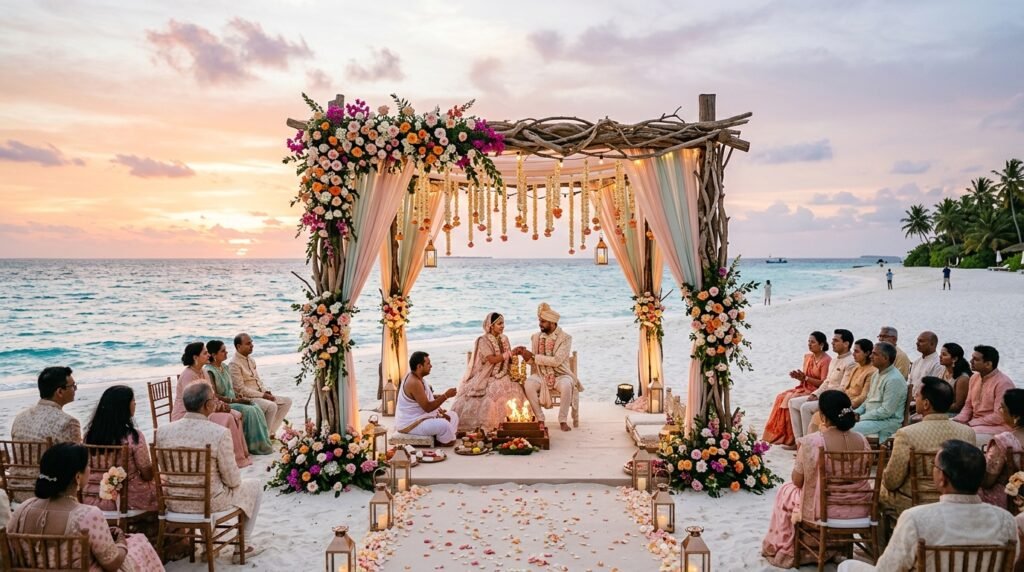
From the palaces of Rajasthan to the backwaters of Kerala, the great Indian wedding is travelling further than ever before.
For generations, the Indian wedding followed a familiar script. The hometown celebration. The neighbourhood banquet hall. The temple where generations before you had tied the knot. It was predictable, efficient, and, frankly, a little uniform.
Not anymore.
The question today is no longer whether to have a destination wedding, but where. And the numbers tell a compelling story. The India destination wedding market was valued at approximately USD 16.25 billion in 2024 and is projected to reach an astonishing USD 55.39 billion by 2033, growing at a CAGR of 14.8 per cent . One in every four weddings in 2025 was a destination event, and among weddings with budgets exceeding ₹1 crore, more than 60 per cent were destination celebrations . This is not a fleeting trend. It is a fundamental recalibration of how Indian couples choose to begin their lives together.
The Shift from Tradition to Experience
The old model was straightforward: marry where your parents live, invite everyone they have ever met, and follow a template that has been used for decades. The bride’s family bore the cost. The groom’s family managed the guest list. The couple’s preferences were secondary.
That script no longer holds.
Weddings today are being treated as experiences rather than obligations. Couples want their wedding to feel personal—something that reflects who they are, not just what tradition dictates . It is the difference between a celebration that feels like a ritual performed for others and one that feels like a memory crafted for yourselves.
“The average destination wedding budget in India has risen to around ₹58 lakh,” notes Mehak Shahani, co-founder of WedMeGood, in a recent report, “while weddings with budgets above ₹1 crore are now largely destination-led” . The average spends on weddings rose by 8 per cent in 2025, driven by the demand for immersive, curated experiences .
The Geography of Love: Where Couples Are Heading
The wedding map of India has expanded dramatically. While Jaipur, Udaipur, and Goa remain perennial favourites, couples are venturing further—into the hills, along the backwaters, and deep into the heart of heritage India.
Rajasthan continues to hold its crown as the quintessential wedding destination, with Jaipur alone hosting over 4,000 celebrations last year . The state’s fort-palaces offer a grandeur that is impossible to replicate elsewhere. But the economics have shifted. A two-night, three-day wedding for 200 guests in Jaipur typically costs between ₹1.2 crore and ₹1.5 crore, with Udaipur commanding a 20 per cent premium .
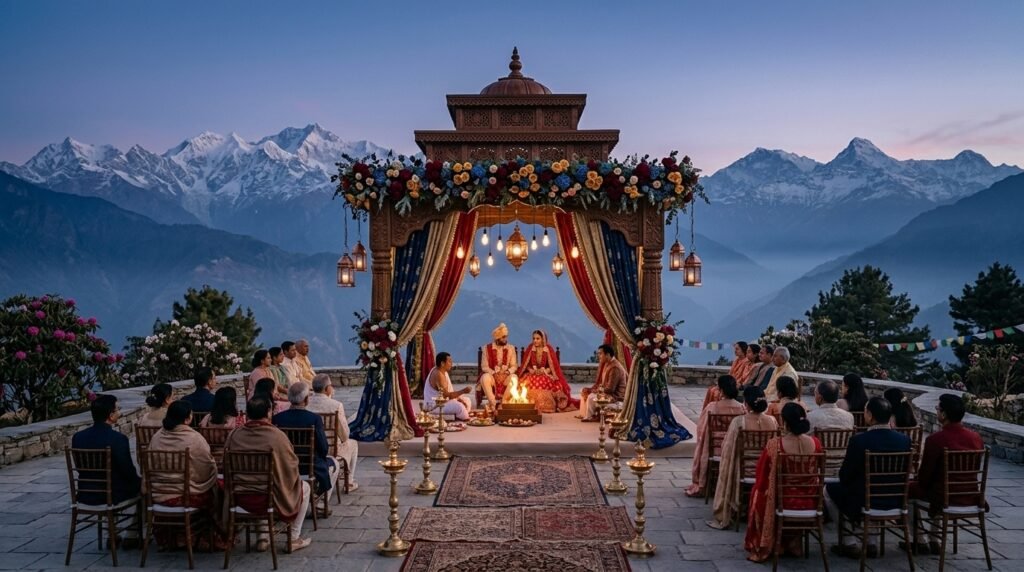
The hills are calling. Couples are increasingly drawn to the mist and mountains of destinations like Mussoorie, Shimla, and Rishikesh . These venues offer something the palaces cannot: a slower pace, intimate settings, and the quiet beauty of nature. Properties such as Welcomhotel Jim Corbett and ITC Hotels Jabalpur now report wedding and social events contributing more than 50 per cent of annual revenue .
Offbeat destinations are no longer offbeat at all. Venues in Orchha, Mandawa, Alleppey, Coorg, and Pelling are gaining significant traction among couples seeking authenticity over spectacle . The allure lies in their uniqueness—a houseboat ceremony in Alleppey, a coffee estate wedding in Coorg, or a Himalayan backdrop in Pelling. These are not venues. They are stories.
Tier-II and tier-III cities are emerging as the new frontiers of wedding tourism, with demand steadily growing in these emerging destinations . For couples seeking value without compromising on beauty, places like Pushkar, Jaisalmer, and Jim Corbett offer costs at roughly 70 per cent, 50 per cent, and as low as 40 per cent of Jaipur’s rates, respectively .
The Economics of the Big Day
A destination wedding is an investment. And like any significant investment, it requires understanding the structure.
Industry data reveals that a five-star destination wedding today typically carries a budget in the ₹3 crore-plus range, allocated across a clear structure: 20 to 25 per cent for premium venues, 10 to 15 per cent for guest and family travel, 10 per cent for artists and crew, and the remaining 50 to 60 per cent for decor, food, and planning .
For those seeking more intimate celebrations—ranging from 50 to 150 guests—boutique venues in offbeat destinations offer wedding experiences starting anywhere from ₹8 lakh to ₹20 lakh . The cost per guest is higher than a local wedding, but the experience is curated, the setting is memorable, and the photographs are priceless.
A common observation: the same budget that covers 200 guests at a destination wedding can host nearly 600 guests in a local city celebration, given the savings on travel and accommodation . The choice is not about value—it is about what kind of celebration you are seeking.
The Policy Push: “Wed in India”
The destination wedding boom has received significant institutional backing. Prime Minister Narendra Modi’s “Wed in India” campaign, launched by the Ministry of Tourism in 2023, has positioned the country as a premier wedding destination . The initiative showcases 25 handpicked venues across beaches, mountains, heritage towns, and cultural heartlands, leveraging influencer marketing and digital storytelling .
In his Mann Ki Baat addresses, Modi has repeatedly emphasised the economic and cultural rationale behind choosing India over overseas locations for weddings . The appeal has resonated. The Confederation of All India Traders (CAIT) reported that India hosted about 3.8 million weddings between November 23 and December 15 last year, generating ₹4.74 lakh crore in revenue—a 26 per cent year-on-year increase .
This is not simply a cultural shift. It is an economic one. The wedding industry now supports nearly 1 crore jobs directly and indirectly across travel, fashion, beauty, decor, food, and logistics . Destination weddings are being described as “pop-up economies,” creating temporary but substantial demand for local goods and services .
What the Numbers Tell Us
The scale of this industry is remarkable. Industry estimates suggest that India conducts roughly 10 million weddings annually, with winter remaining the most concentrated period for high-value, multi-day celebrations . The destination-wedding segment alone accounts for a growing share of this, with one in every four weddings now falling into this category .
Hotel groups are reporting unprecedented demand. Radisson Hotel Group recorded an 87.1 per cent year-on-year increase in room revenue from weddings in November alone, supported by 27,000 room nights, up 46 per cent from last year . The group noted November as its best-performing month ever.
At Leisure Hotels Group, a single Corbett property is expected to close the wedding season with approximately ₹15 crore in wedding revenue, compared with ₹11 crore last year . Industry data suggests that hotel-led wedding business has grown 10 to 12 per cent in 2025 .
The Evolution of the Guest Experience
Destination weddings have fundamentally changed what guests expect—and what they receive. The traditional one-day affair has given way to multi-day celebrations that feel more like curated retreats than weddings.
Wellness integration has become a significant differentiator. Pre-wedding yoga sessions, spa treatments, and curated wellness experiences are increasingly common, particularly at hill and beach destinations. Guests are arriving early not just for the wedding but for the experience of being there.
Curated hospitality extends beyond the couple to the guests themselves. Welcome kits, local experiences, guided tours of the destination, and carefully curated meal experiences have become standard features of destination weddings. The wedding is no longer just about the couple. It is about creating a memorable experience for everyone who travels to be part of it.
The rise of the wedding weekend has redefined the timeline. What was once a single ceremony has expanded into a three or four-day celebration, allowing for intimate moments, relaxed interactions, and genuine connection between families.
Technology and the Modern Wedding
The digital transformation of Indian weddings has been significant. Online planning platforms have simplified everything from vendor selection to budget tracking, making destination weddings more accessible to couples across income brackets .
Virtual site visits have become standard practice, allowing couples to shortlist venues without travelling to each location. Digital invitations are increasingly replacing traditional paper cards, particularly for the wider guest list. Wedding websites serve as central hubs for all information—from travel arrangements to dress codes to gift registries.
Social media has made every wedding a story, and every story needs a setting that stands out. The demand for cinematic backdrops, candid photography, and Instagram-worthy moments has become a primary driver of destination weddings. Couples are choosing venues not just for the experience but for the imagery that experience will produce.
The Global Context
India is not alone in this shift. Destination weddings have been growing globally, but the Indian version has its own distinct character. The Indian destination wedding is rarely just a ceremony. It is a multi-day festival, complete with multiple events, elaborate rituals, and hundreds of guests.
International destinations like Thailand, Bali, Maldives, Italy, and Greece continue to attract Indian couples seeking iconic backdrops for their celebrations . The allure of international weddings lies in their prestige, the novelty of the location, and the sense of occasion they create.
The practical challenges, however, are significant. International weddings come with visa complications, currency fluctuations, language barriers, and the difficulty of coordinating with vendors unfamiliar with Indian wedding requirements . For many couples, the domestic option has become increasingly compelling—offering comparable beauty at a fraction of the complexity.
The Future of the Indian Wedding
Several enduring trends are likely to shape destination weddings in the coming years.
Intimate celebrations are becoming the preferred format for many couples. The pandemic accelerated a shift toward smaller, more meaningful gatherings—and that preference has not reversed. The “big fat Indian wedding” still exists, but alongside it, a quieter, more intimate model has emerged .
Sustainability is increasingly influencing choices. Eco-friendly wedding options, from décor to catering to accommodation, are gaining traction among environmentally conscious couples. Destination weddings are particularly well-suited to this trend, allowing for deeper integration with local ecosystems and communities.
The rise of “wedding tourism” is creating new economic opportunities for smaller towns and emerging destinations. Wedding planners report that “lesser-known destinations are gaining significant traction among couples who want to get married in a more intimate setting that offers a unique experience” .
Regional experiences are becoming central to the destination wedding. Couples are increasingly incorporating local cuisine, traditional crafts, and regional music into their celebrations—creating weddings that feel grounded in their location rather than simply staged there.
Destination weddings are no longer a luxury reserved for the elite. They are becoming the new normal—a choice informed by aspirations, enabled by rising incomes, and shaped by a generation that values experience over obligation.
The palaces of Rajasthan will always hold their allure. The beaches of Goa will always draw crowds. But the weddings of the future will be different. They will be smaller, more intimate, more personal. They will happen in places that tell a story—a coffee estate in Coorg, a lakeside mandap in Shillong, a Himalayan meadow in Auli.
The script has been rewritten. And for an entire generation of couples, that is precisely the point.