
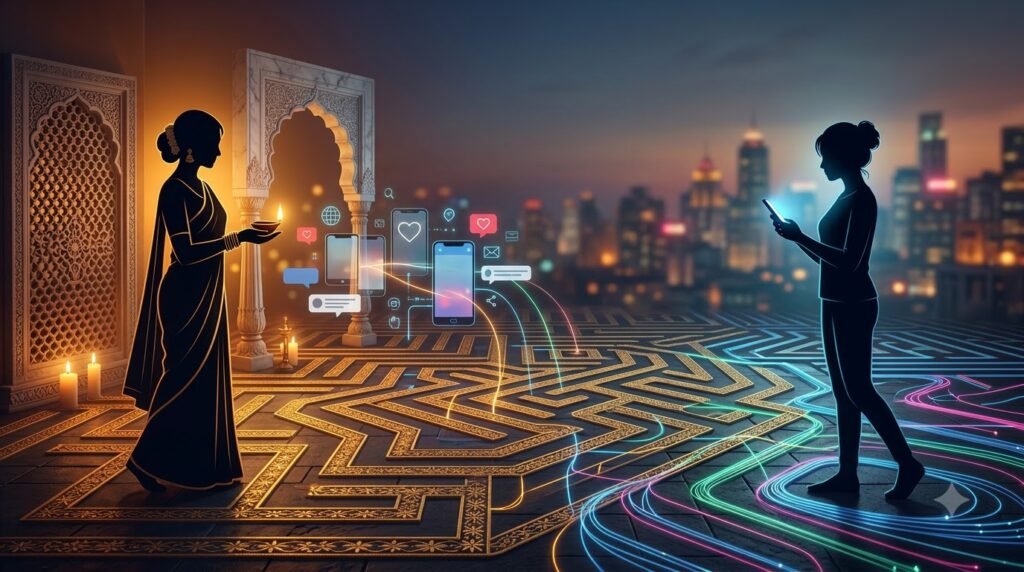
If you’ve been in a relationship in India anytime in the last decade, there’s a good chance it has felt complicated in ways that are hard to explain to someone older.
Not bad, necessarily. Just… layered. Like you’re constantly negotiating something, even when things are going well.
The numbers tell part of the story. Over the last four years, nearly 3,000 divorce petitions have been filed in Goa alone, with both districts recording a steady rise every single year . Across India, the upward trend is not slowing. In South Goa, lawyers note that no fewer than five matrimonial cases are listed daily in each court . These are not merely statistics. They are signs that relational stressors are building long before couples reach the point of marriage, let alone divorce.
But divorce numbers, as alarming as they are, tell only half the story. Beneath them lies a quiet but massive shift in how young Indians are forming, sustaining, and interpreting their relationships. The experiences of young people no longer fit into the old binary of “single” or “married” . This is the part of our society that has not yet understood—or prepared for.
The New Vocabulary of Modern Love
A decade ago, the language of Indian relationships was relatively simple. You were either dating, engaged, or married. The path from one to the other was well-marked.
Today, young people navigate emotional terrain shaped by technology, independence, fluid identities, mental health struggles, and a wider set of choices—all of which profoundly redefine intimacy . But our schools, colleges, families, and even policy frameworks are still positioned around outdated assumptions of how relationships form.
One of the most visible manifestations of this shift is the rise of situationships—relationships that exist without labels, where emotional intimacy and closeness develop rapidly but without clarity or commitment. While this seems convenient to young people wary of pressure or traditional expectations, it often leads to emotional burnout, jealousy, ghosting, and unresolved hurt .
Similarly, Living Apart Together (LAT) relationships are becoming more common, often among financially independent young women who do not want marriage to erase personal autonomy . These relationships show a new understanding of commitment, where love is preserved by maintaining boundaries and space, not dissolving into a traditional joint household model.
Digital-first relationships have become the norm. Many young people today meet through Instagram, WhatsApp, or gaming communities rather than physical spaces . Digital intimacy creates quick emotional bonding but also exposes them to modern relationship risks like ghosting, cyberstalking, screenshot breaches, digital cheating, and online emotional abuse. Yet there is no institutional language or guidance around navigating digital intimacy responsibly.
The Expectation Paradox
Perhaps the most exhausting aspect of modern relationships is the gap between what we want and what we can actually deliver.
The modern relationship checklist has become absurd. Men are expected to be emotionally mature, financially secure, progressive yet protective, confident yet humble—part poet, part banker, part therapist . Women face a parallel dilemma—independent but soft, career-driven but nurturing, modern yet traditional .
This unrealistic pursuit of perfection breeds resentment. What used to be companionship has become performance—one misstep and love turns into disillusionment .
Indian millennials and Gen Z are the first generation asked to hold two completely different models of relationship in their heads at the same time.
On one side, there’s the traditional model. Marriage is a family alliance. Compatibility is measured in horoscopes, caste, income, and how well your personalities “fit” within a socially legible framework. Love, if it comes, comes after commitment. The relationship is embedded in the community.
Dating Apps Changed the Dynamic Completely
India is one of the largest markets for dating apps. Tinder, Bumble, Hinge, and their desi equivalents like Aisle have millions of users. And yet, the way most Indians use these apps reveals a deep cultural ambivalence.
People are simultaneously on Shaadi.com for the family and on Hinge for themselves. They have conversations with matches they’ll never introduce to their parents. They go on dates they’ll describe to friends but not acknowledge to relatives. The compartmentalisation is exhausting, and it creates a kind of double life that adds friction to every relationship before it even properly begins.
Dating apps have also introduced something that relationship psychologists call “the paradox of choice.” When there are always more options visible on a screen, commitment to any single person starts to feel like closing a door. There’s always the nagging possibility of someone better, someone easier, someone who fits more cleanly. This isn’t unique to India, but it plays out differently here because the stakes of getting it wrong feel so much higher when family expectations are built in.
The Parental Interference Factor
Marriage in India has traditionally been seen as a union not just between two individuals but between two families . This cultural context, while fostering strong familial bonds, can also lead to significant challenges when familial boundaries are not respected.
Research has shown a significant association between parental interference and marital instability, with an overall effect size of 0.65 . Excessive parental involvement often leads to feelings of resentment, loss of privacy, and conflicts between couples, exacerbated by the husband’s feelings of being overshadowed and the wife’s divided loyalty between her parents and spouse .
Studies have found that couples who experienced high levels of parental interference were significantly more likely to consider divorce as an option during conflicts—with a reported divorce rate of 45% in such scenarios compared to 20% in marriages with low parental interference . This reflects a shift in societal attitudes where younger generations increasingly value individualism and autonomy within their marriages, often clashing with traditional expectations of family involvement.
The “Are We Even Compatible?” Spiral
Modern Indian couples talk about compatibility more than any previous generation. And the conversation has become increasingly complex.
It used to be about basics: religion, caste, lifestyle, values. Now compatibility conversations cover emotional intelligence, communication styles, attachment patterns, love languages, introversion versus extroversion, financial philosophies, and how each person deals with conflict.

Despite the complexity, there is a quieter narrative emerging. A 2025 survey of over 3,400 urban singles found that 9 in 10 respondents now prioritise meaningful, long-term relationships over fleeting flings . This shift is led by an overwhelming 97% of women across both Gen Z and Millennial generations who have categorically rejected the “swipe-and-discard” culture of the last decade .
This widespread “casual dating fatigue” is measurable, with 1 in 4 Indians actively reducing their frequency of low-stakes dating in just the past year . For those entering the dating pool now, the goal isn’t just to find a partner but to find one with a clear timeline, as one in three millennials expresses a desire to move from the first date to marriage within a single year .
The drive for a committed partnership is even reshaping how the check is handled. Financial independence is now a core component of the romantic contract, with 53% of women preferring to split the bill to establish autonomy and ensure a relationship starts without the weight of unspoken “social debt” .
Mental health has entered the dating conversation. Over half of all respondents now believe therapy talk belongs in dating conversations . Emotional maturity has officially become the new currency of love.
What’s Actually Going On
If love in the 2010s was all about chemistry, love in the 2020s is about consistency. The modern Indian dater has changed. They’ve been through enough ghosting, breadcrumbing, and emotionally unavailable situations to last a lifetime. What they want now is simple: someone who shows up, listens, splits the bill, and knows their way around feelings.
The tragedy, or perhaps the mercy, is that most relationships persist not because they’re euphoric but because they’re stable. Predictable. Two people locked in the comfortable mathematics of mutually assured inertia. This isn’t necessarily a failure. Stability has its own value, especially in a world that offers little of it elsewhere.