
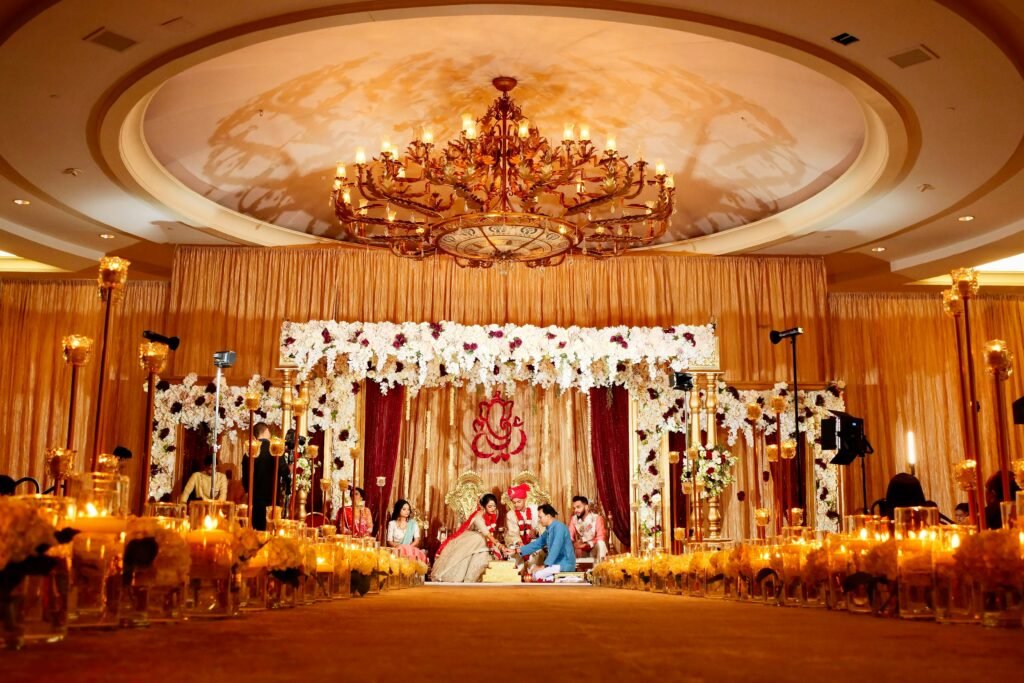
Indian weddings are famously elaborate. We’re talking multi-day celebrations, guest lists that run into the hundreds, budgets that would make a small business owner faint, and a production scale that puts some concerts to shame. The question isn’t whether this is “too much.” The real question is what it says about us, as a culture, and what we’re really trying to accomplish when we throw a wedding like this.
The numbers are staggering. The Indian wedding industry is valued at approximately $130 billion annually, making it the fourth-largest sector in the country, second only to the food and grocery industry within the overall retail market . Indians spend more on their child’s wedding than on 18 years of education . The average Indian allocates roughly five times the per capita GDP towards weddings . From November 2023 to December 2023 alone, about 3.5 million couples had weddings, generating spending of approximately Rs 4.25 trillion .
These numbers are not merely economic data. They are evidence of a psychological phenomenon – a collective investment in spectacle that transcends rationality. To understand the “big fat Indian wedding,” one must look beyond the shimmer and examine the forces that drive families to spend beyond their means, to invite people they barely know, and to turn personal milestones into public declarations.
It’s Never Just a Wedding
In Indian culture, a wedding has always been bigger than the two people getting married. It’s a public declaration of family standing, an announcement to the community, and a social event that will be discussed, compared, and remembered for years.
This isn’t something to feel embarrassed about. It’s deeply sociological. Sociologist Erving Goffman wrote about how human beings constantly perform identity for an audience. Indian weddings are one of the grandest stages for that performance. Every element — the venue, the outfits, the catering, the décor — signals something to the people watching. And people are always watching.
For families that have worked hard across generations to build stability, a wedding is a moment to say: We made it. Whether that’s a family of farmers who moved to a city, a middle-class household whose child is marrying into something “better,” or first-generation immigrants abroad trying to hold on to their roots — the wedding carries all of that weight.
The Social Status Imperative
Here is something most people won’t say out loud: a huge chunk of Indian wedding spending is about preventing social shame, not creating joy.
There’s a concept in social psychology called “anticipated regret” — the fear of how we’ll feel if we don’t do something. For many Indian families, this fear is very specific: What will people say if we did it small? What if they think we couldn’t afford it? What if our relatives feel we didn’t respect them enough to invite them?
So the guest list grows. The event expands. The budget stretches. Not because the couple asked for it, but because saying no to any of it feels like failure, like not caring, like letting the family down.
This loop runs deep. And social media has made it significantly worse. Now it’s not just about what people saw at the wedding; it’s about what they see on Instagram after. The professional photographer, the cinematic reel, the viral sangeet video. The audience has expanded from 300 relatives to potentially thousands of strangers.
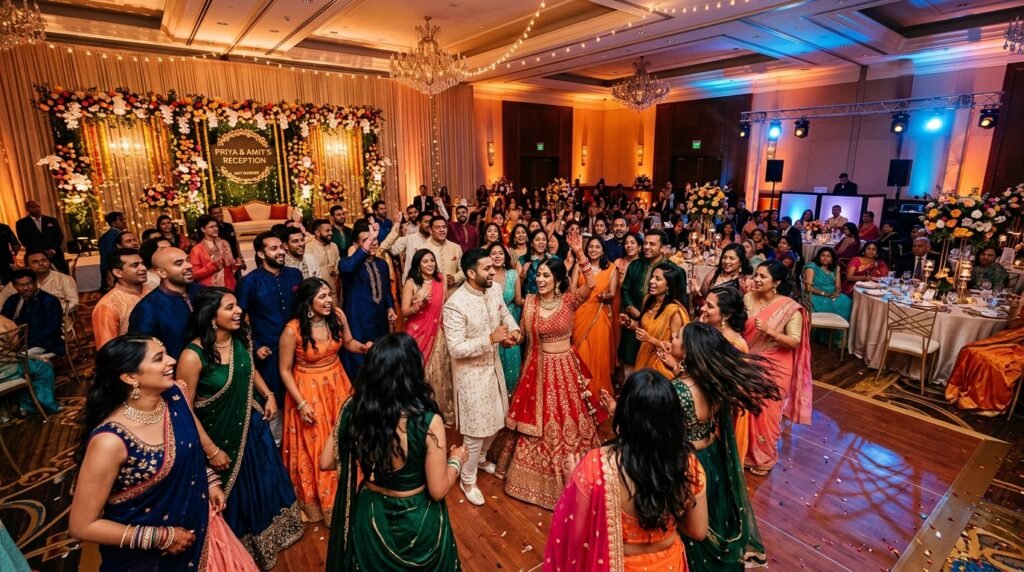
Every guest invited, every dish served, every decoration displayed sends a signal about the family’s position in the social hierarchy. The fear of community judgement, of being criticised or excluded for not meeting traditional standards, often pushes families to host elaborate celebrations that their budgets cannot comfortably support
The Emotional Dam Break
There is a concept that captures the psychology of wedding spending well. Kunal Shah, founder of CRED, has described it as a “dam break”—the moment when emotional investment overrides practical financial planning . While Indians can be frugal in everyday life, emotions overcome practicality during life’s biggest milestones .
This emotional intensity is shaped by cultural narratives. The “big fat Indian wedding” as we know it today did not always exist. In the decades following independence, food shortages were acute. The Essential Commodities Act of 1955 restricted food supply and distribution, and in most states, you could not invite more than 25 people—and if you did, you could not serve them food . Moreover, it was considered unbecoming for families to display their wealth through weddings .
The shift began in the 1990s, with economic liberalisation and the rise of disposable income. But the cultural catalyst was perhaps even more significant. Films like Hum Aapke Hain Koun..! triggered a cultural shift, depicting weddings as dramatic, dazzling, multi-day events that became aspirational models for millions . The Bollywood wedding entered the collective imagination, and the “big fat Indian wedding” became the norm .
Today, social media has amplified this effect. Platforms like Instagram allow couples to envision their dream weddings through the experiences of others, often raising the bar for what they want to achieve . Celebrity weddings—from Anant Ambani and Radhika Merchant’s estimated ₹5,000 crore spectacle to Deepika Padukone and Ranveer Singh’s Lake Como celebration—set aspirational goals . The desire to recreate cinematic experiences and post-perfect pictures online pushes budgets even higher .
What the Wedding Actually Costs (Beyond Money)
The financial cost of an Indian wedding is easy to see on a spreadsheet. What’s harder to quantify is the emotional cost.
There’s the couple, often managing expectations from both families simultaneously. There’s the stress of decisions, vendor negotiations, outfit choices, and seating arrangements. There’s the sheer exhaustion of being “on” for three days straight — performing happiness, greeting distant relatives, smiling for photographs when you’re running on four hours of sleep.
And then the wedding ends. And often, nobody asks how the couple is actually doing.
Some research on post-wedding depression suggests that the period after a large, highly anticipated event can bring a significant emotional crash. When you’ve spent months anticipating something and building it up as a defining moment, the ordinary days that follow can feel strangely empty.
This doesn’t make the wedding wrong. But it does suggest we need to think about what happens after the shaadi — not just during it.
The Generation Pulling in Two Directions
And yet, change is visible. While the big fat Indian wedding remains dominant, a quieter revolution is taking shape. Gen Z couples, in particular, are increasingly drawn towards intimacy over spectacle .
Those getting married during or immediately after the Covid-19 pandemic were forced to do so in small, intimate gatherings, and the appeal of getting married in the company of just family and friends seems to have caught the fancy of younger couples . A wedding album filled with barely-known people is no longer the ideal way to remember the big day .
As one young bride put it, “I believe that you are going to get married only once. So, you should live all your dreams. But the privacy felt good, and we did not spend too much on the wedding to save up for travelling” . Another echoed the sentiment: “I don’t believe in giving into the conventional pressure of throwing big parties and inviting thousands of people. I could spend a crore on booking lavish hotel rooms for people who are closer to my parents than me, but I would rather spend that money on buying a house together or on the honeymoon” .
Wedding planners confirm the shift. According to Ritwik Mitra, founder of ORIZO Events, there is a difference between when the couple approaches them and when parents do. While parents want grandeur, young people want minimalism and elegance . Sustainability is another trend, with the usage of artificial flowers rising massively in recent years .
However, parental pressure remains a significant factor. As Harshita, a teacher who got married recently, explained: “I wanted a very intimate affair… However, for both our families our wedding was the only occasion that they could celebrate on a big scale. So, we went with the typical big Indian wedding” . Social media, too, plays a dual role—while it inspires some couples towards minimalist aesthetics, it also glorifies extravagance and creates pressure
The Economics of Emotion
The psychology of the big fat Indian wedding is rooted in a fundamental tension between emotional aspiration and financial reality. Many families find themselves spending far beyond their means, influenced by emotions, traditions, and the urge to match social expectations .
This tension is not lost on the couples themselves. One finance entrepreneur, reflecting on the societal pressure, said: “I honestly do not know how the Ambanis would do a wedding on this scale if they did not have this seemingly endless source of wealth because it is not plausible. Real Indian weddings focus on saving money while having everything that you ever wished for on the big day. Spending vivaciously on one night or probably a week does not sound sensible” .
Some wedding planners note that couples are now “spending smarter” rather than simply spending more. Intimate weddings allow families to redirect budgets toward key elements such as films and edits while saving through e-cards, minimal décor, and combined photography teams . The allocation to photography and videography, for instance, has grown from 3-4% to 7-10% in many urban weddings, reflecting the understanding that “décor fades, outfits get packed away, but the visual narrative of the celebration becomes their lifelong keepsake.”
The Unresolved Tension
The psychology of the big fat Indian wedding is ultimately a story of unresolved tension. Between tradition and aspiration, between the desire for intimacy and the pressure for spectacle, between the wedding and the marriage.
The institution continues to evolve. The big fat Indian wedding is not going away—the wedding industry is simply too vast, too culturally entrenched, and too emotionally charged to disappear. But its shape is changing. Couples are asking for more personalisation, more meaning, and more authenticity . They are questioning the guest list, the unnecessary rituals, and the financial burden . They are shifting focus from the size of the celebration to the quality of the experience.